|
|
ENTRANT INFORMATION BOOK A-Z (Alphabetical Order) Age
18 (on race day) to 99. Because if you're too old
for Lego, you're too old for this. Younger age limit
is about the risk profile we present to the
insurance company.
Aid StationsWill be positioned per
the overview map on "The Trail" page. There will be water,
32Gi sports nutrition and basic first aid equipment
available at each aid station. Coke comes out for the tail
end of the 28km and the 56km return. If you wish to have
your own equipment on hand for use at Dromana,
HyslopsRd South or Boneo Rd aid stations, you can
create a special needs "drop bag" clearly marked with
your name and race number. You need to hand these over
at Dromana on the Saturday noon-5pm. (See S for
Special Needs for more details.) For locations on a map
of all aid station sites please see "The Trail"
page. This is a Trail
Run, primarily through National Parks. Cups will NOT
be used or provided. Runners must have a
500ml min capacity hydration
device/bottle/camelbak/fuelbelt to carry water with
them, at all times, that is full at the start of the
race. The Ambulance service
is not a free service in Victoria. It's your
responsibility to check your health cover and ensure
you are covered for ambulance cover in the case of an
emergency. To arrange cover with Ambulance Victoria,
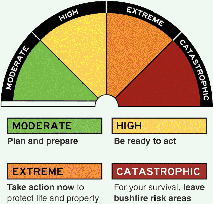
visit http://www.ambulance.vic.gov.au/ Due to the run going through Parks and we are subject to closure in the event of Extreme or Catastrophic rated fire days, permits have also been sought to run the event on the following weekend, if it becomes necessary for that or any other reason. In the event that the event can't be commenced on January 17th 2027, it will be rescheduled to be run on January the 24th 2027. Delivery
of bags for 28km runners to
their finish
at Cape Schanck is available
on race
morning. Look for the
large truck near the beach
end of Permien St Dromana
on race morning.
We supply the tags. You supply the bags. but, pre-marking your items will save you and us time. For special needs/drink delivery to on-course locations see S for Special needs. Bag Minding. 56km -
Cape Schanck.
56km
runners can leave their
bags near race number
pickup at Cape Schanck.
Those bags will then be
transferred to the 28k Bag
Delivery truck when it
arrives at Cape Schanck.
56k runners pickup your
bags from the Baggage
truck when you've
completed your run.
We supply the tags. You supply the bags. but, pre-marking your items will save you and us time. For special needs/drink delivery to on-course locations see S for Special needs.
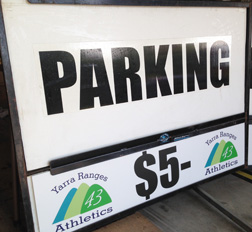
At Cape Schanck, (the
28km finish and 56km start), there are 117
standard car spaces and 3 disabled spaces in the
asphalt car park. We encourage car pooling where possible. We have arranged for
limited roadside parking at the southern end of the
Cape Schanck Road. (Not normally allowed). Further parking at the Cape Schanck end of the course can be found at Fingal Picnic Area. (1.6km north of Cape Schanck Lighthouse.) Approx 80 car spaces there. 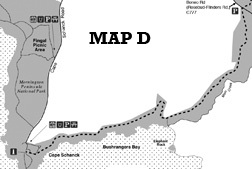 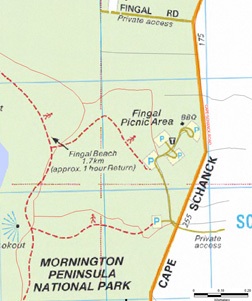
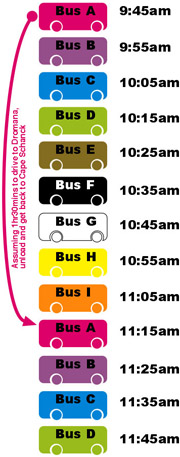
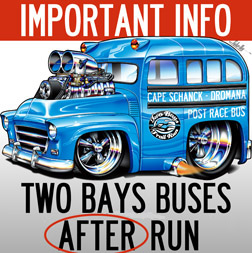
See T for Transfers.
Course is measured and
certified to PDA standards. 28km for the one way trip.
56km for the two way trip. (In reality the 28k is
about 27.55km)
Cut-Off Times If you can't complete
the 28km in under 4 hours (from
your wave start time), or the 56km in under 8
hours (from
your wave start time) you should
not enter that event. Why are there Cut-Off times? See
also "Q for Qualification Standards" lower down. Participants finishing
outside of cutoff times will not appear in the final
results. Cut-off
Times for 56km Runners. 28km
Dromana 3h45m after wave start. Runners
will be officially withdrawn from the event if they
have not departed on the return leg of the event by
those times listed above.
Rotten Boardwalks. There are boardwalk
sections covered in chicken wire. Large runners (80kg
plus) are advised to take it easy as some of the
boards are rotten. Snakes. First Aid for Snake Bites: Stop lymphatic spread - bandage firmly, splint and imobilise! The pressure-imobilisation approach is simple, safe and will not cause tissue damage (ie, from incision, injection, freezing or arterial torniquets - all of which are ineffective). See Dr. Cheryl's
youtube video of how to do it. Weather: It may be hot. Do not attempt this run without carrying fluids. * Drink the Right
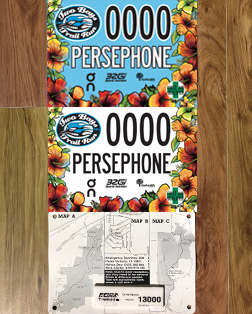
Amount of the Right Fluids * Replace Lost Electrolytes * Wear Appropriate Clothing * Use Sunscreen and Avoid Sunburn * Acclimate to the Heat Getting lost. The course will be well marked, but fatigued runners tend to develop tunnel vision. Keep your wits about you and keep an eye out for orange markings/ribbons/cones. The Two Bays track also has official markings that are a blue wren symbol. Maps are on your race-bibs but familiarizing yourself with this map before hand could save you a lot of time on the day. Bring a mobile phone on the Telstra network so you can contact others. If you are a GPS wearer learn how it use its features and learn how to retrace your steps using the map facility.
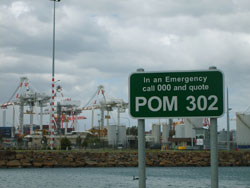
Obviously you could be quite some distance
from the nearest marker, however if you call race
organizers and can tell us how many kilometers into
the run you are, we will have access to maps that
help identify the number of the nearest ESTA marker.
While the preference is to
re-route, detour, or turn the races into shortened
OutNback routes, in a mass emergency situation we
may need to evacuate runners. You may be held at
the next aid station while arrangements are made.
Below are maps showing possible routes used, and designated bus pickup areas. When training on the course, please make note of the locations of evacuation routes, and bus evacuation locations. 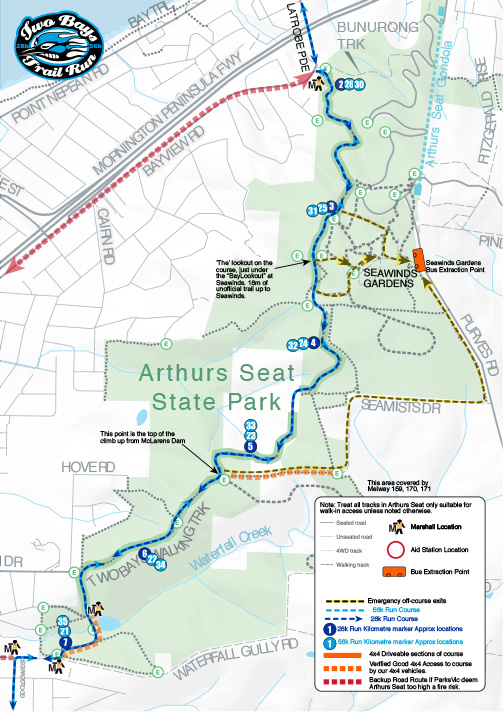 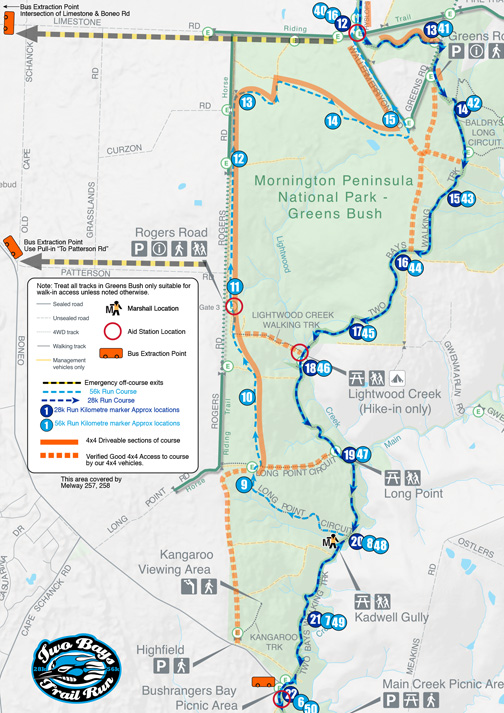 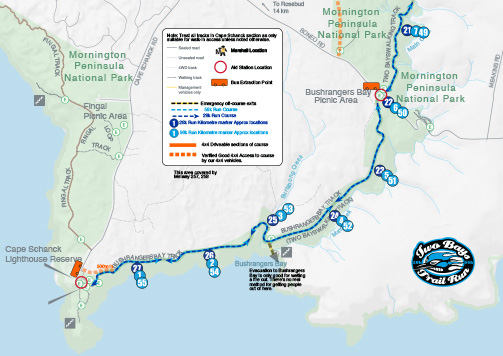 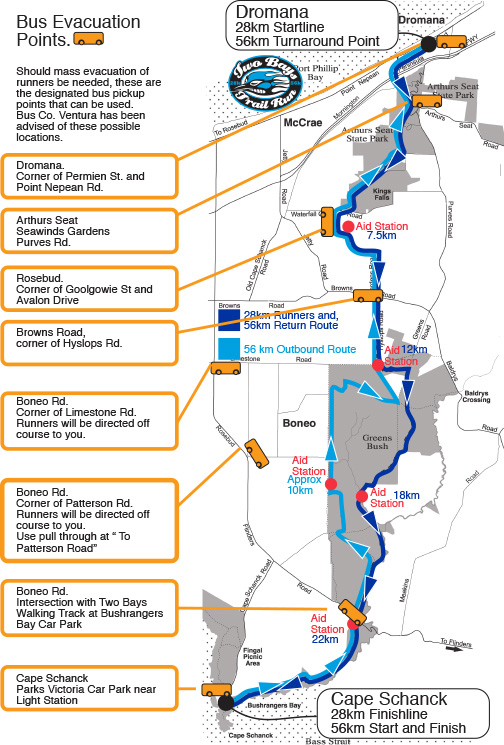 Field Limits We'll be applying for
1800 runners for the 2027 event.
The event has sold out every year until the Covid Pandemic. Numbers were less in 2021 and 2022. 2023 and 2024 were back to full strength, but didn't have the "sell-out" button pressed. 2025 got extremely close.... No we can't predict precisely if or when. (Generally late Nov through to late Dec, depending on the year.) No we can't send you a personal email when its down to the last 50 entries available. Note: Sometimes we need to close off 28km entries ahead of the 56km entries as about one hundred 56km entrants will make late changes to become 28km entrants. First Aid Providers EMS First Aid service
is being used. Major locations will be at Dromana and
Cape Schanck, with visits to Rosebud street section
and Boneo Rd. Green crosses on some peoples race numbers mean they have level 2 or higher First Aid Qualifications. If you are in a bad way appeal to them, if you have a widdle gwaze then leave them alone they are racing too. Everyone should help a runner in serious trouble. Two Bays Trail Run
prior to the 2011 event was a FATASS event. (No Rules,
No Aid, No Wimps etc.) The idea of using the trail
came from Kevin C. Impetus in the early years was
provided by 'Virtual'. The 2010 event saw numbers grow
to 86 and the attention of the authorities was
attracted. Thus the 2011 event was the 7th Two Bays
Trail Run, but the first official running of the event
with all the necessary permits and consultations
having taken place. 2011 saw over 400 people finish.
2012 had close to 700 finishers. 2013 had over
900 finishers. 2014 & 2015 about 1000. 2016 &
2017 about 1100. 2018 & 2019 had a bit over 1300.
2020 had almost 1500 finish. 2021 was a mess on the
capping due to Covid regs interpretations from various
govt. bodies. Capped at 500, then 2x500, then opened
up to 1500, but too late for most people to hear about
it. (Event is usually capped by ParksVic and that cap
has been slowly increased.) 2022 had the great Omicron
exodus and went from over 1600 entrants to 1220
finishers. 2023 and 2024 were just under 1600
finishers. 2025 had over 1700. 2026 had about 1650. Big Long Run is covered for
Public Liability Insurance though Athletics
Victoria and is affiliated with AthsVic.
What that means for runners with AthsVic memberships, or those in affiliated recreational running groups who've paid their dues, is that you have access to personal accident insurance. We strongly encourage runners to get AthsVic recreational runner memberships. Otherwise you're just relying on Medicare, and/or your own health insurance which could leave you further out of pocket.
ITRA / UTMB Frequent Flyer Loyalty Points Scheme No. We aren't participating.
However, if you really want the points, want to deal with the European bureaucracy and pay the Euros, then feel free to do the paperwork and get it organised. (Some years ago a runner did this for Two Bays without even telling us.) Lost Property
Cape Schanck and Dromana do have lost property boxes. Many lost items get put in the nearest box during pack up. 5 vehicles transport gear back to Melbourne Sunday night and it gets placed in a garage. Over the next few days items get unearthed, photographed and put up in a couple of batches in the facebook group. Link at top of page. Drop bags that appear of possible value are included in these photos. If you see something that's yours send a self addressed postage bag (inside a smaller envelope) and we'll mail your items. Mandatory Gear See R for Rules. Rules 14,17 and 18 in particular. Also see C for Clothing. Massage Providers
Pre-Event.
Is available by either editing your
registration. Or by using using this link.
At the event. Best selection on Saturday, Noon - 5pm at Permien St Dromana. (Race Number pickup session), and; What's left is available for sale on Sunday at the Cape Schanck finish line. If you didn't select the postage option, then your garment is available for collection at merchandise sales at those above times and locations. FAQ. I ordered a t-shirt a while back, but it hasn't arrived. When will I receive it? A: It probably means you didn't add postage. Check your registration email/receipt. Contact us if it was supposed to be posted, and we'll start chasing. If you now want your item(s) posted and hadn't added postage earlier please add postage. We're taking the wider 'ultra' version of pacing, where 'pacers' are there to help particular entrants in whatever way, rather than in the track sense of being there to set a particular pace. The reality: we're
a mixed event on a public trail. If you're not a
paid entrant, we also can't stop you from using a
public trail. But non-entrants do clog the trail
for entrants, and we as organisers wind up being
held responsible for them by authorities,
insurance company etc. In the event of us
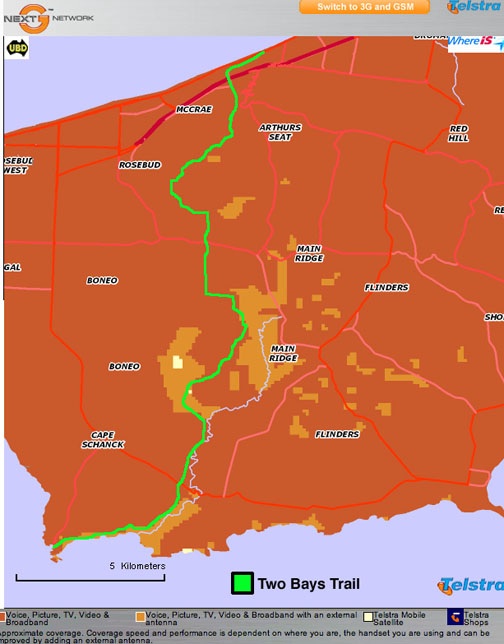
identifying pacing you may be disqualified. This is a real issue. Some carriers have very limited coverage. Prior experience tells us that Vodaphone has very little coverage in the whole southern half of the course The Telstra network
shown in the map below has fairly good coverage and we
advise using them for your safety and that of
others. Telstra 'service' totally sucks, but the
network is about as good as it gets. Having 1800 extra
phones in the area can overload the cells in the areas
of dodgy coverage, so be aware that at Cape Schanck
you may not be able to make calls. Local taxi drivers
advise that Optus has decent coverage. Text messages are more
likely to get through with bad network connectivity
than voice calls.
Poles -
Hiking Poles
Prizes - Podium / Money All
first place getters in the 28km run and the 56km run
receive free entry to Two Bays Trail Run the
following year.
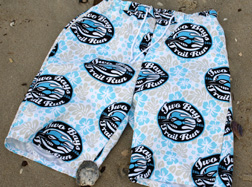
Bonus $50- to all place getters (first to third, F and M in both the 28km run and 56km runs) who complete visibly clad in boardshorts, Hawaiian shirts or swimwear. (that's not just, start or finish in said items). Remember there are on-course photographers. Just starting or finishing in the right gear is insufficient. Please Note: We used to run around trying to chase up all the podium people. It was kind of like herding cats. So now presentations are at fixed times. See program of events below. The cunning plan... If a place getter doesn't show up at presentations, another runner will be selected from the crowd to stand up on the dais and receive the missing runner's prizes. (Excluding the cheques available to the podium people.) Incentive to be there! Cheques will be mailed the Wednesday after the race to those podium people who wrote a post (not just a comment) of 50 words min about their Two Bays race in the facebook group (not to our organization page, or their personal page, or some other place) and posted it by midnight Tuesday after the race. The running public will love hearing from you under your own name.
Program of Events 2027 Sat
16 Jan
Noon-5pm Race Number Packet Pickup from Dromana. Vendors open. Sun 17 Jan 6am Race Number Packet Pickup at both start locations. 7am 28km runners start from Dromana. (Wave started) 7:10am 56km runners start from Cape Schanck. (Wave started) 9:30am 28k presentations. 10:55am Cutoff time for 56km runners to have departed Dromana on their return journey to Cape Schanck. 11am Cutoff time for 28km runners to have finished by. 11:45am Mens 56k presentations. 12:30pm Womens 56k presentations. 3:10pm Cutoff time for 56km runners to have finished by. Qualification Standards / Ranking data, for 2027 Yes it
can be a Garmin / Strava link.
No it doesn't have to be at an official event. Top tip: Don't set it to Private. Qualification Standards are firstly for safety. (It's a long run, in summer and access has difficulties at some points.) Secondly to not overly test the endurance of our lovely volunteers. Thirdly we have the 56km event going on at the same time as the 28km run which presents course constraint issues. Tail end 28km runners intersect with the 56km runners at the Gardens Road reserve. (Narrow Point). Tiring 28km participants also intersect with lead 56km runners at the end. Fourthly, we'll admit that Traffic Management and First Aid cost a bomb. We can measure each quarter hour the course is kept open in hundreds of dollars. Fifthly, with the shift to wave starting in 2020, we needed comparable data to rank runners for those waves. Two Bays, and half/mara Run results provide far better, more comparable data than say, small field, mountain hike-run events.
56km Qualification / Ranking Data: (Data submitted is also used for wave-sorting, so if you want an earlier wave, and have a couple of potential qualifiers, use the qualifier that best showcases your abilities.)
For those who don't have a current qualifying time when entries go live please enter if you think you can run one before Christmas 2026. The online entry procedure will give scope to write a short note re your ability and plan to run a qualifier. Please then email the Judge, and update your registration (by editing your registration), once you have run a qualifier stating distance and what time you ran. (With link to your run.) People who have paid entry will have until Christmas to qualify and update their registration with that qualification time/event and link. Qualification enquiries email:  ***Special Note about Half Marathon qualifying times. It is sub 2:15. Not 2:25-but-I-had-to -stop-twice-to-go-to-the-toilet-so-really-this-is-a-sub-2:15. If your toileting needs are such that you have to go that frequently then you are going to have go more times during Two Bays and not less. Super Special Note: If you are someone who believes all figures have wriggle room, then please think of the half mara sub 2:15 criteria as being sub 2:10 with 5 minutes of wriggle room.
Refunds Road Crossings & Sharing There are two major
road crossings. Browns Road, and
Boneo/C777/Rosebud-Flinders Road. Cars have right of way at these , and all other
road crossings in the Two Bays Trail Run. Latrobe Pde and the
Rosebud Street section are both Road-Sharing
situations. Speed limit reduction and warning signs will be employed, but be aware you may be delayed a minute or so on occasion. People
tend to believe they are exempt from rules, so
unfortunately a few years back we had to start using
disqualification as a method of attaining overall
compliance. It works, but it's sad for the runner
and the organisers. Please avoid sadness.
FYI the most common causes for DQ are breaches of rules 13, 15 and 18.
We are fortunate to be
allowed access to the trail to run our event, so
please make sure you leave no trace of having been
there. Take all rubbish with you, place it in bins at
aid stations, or risk disqualification. Your fastest way out, other than running/walking is likely to be Uber / Taxi / Phone-a-friend. The course manager can't drop everything to come and get you, but will pickup runners as time permits, or as the event packs up. Runners who drop out at the Greens Bush aid station will have to wait until it packs up for a lift out. If you can walk then walking through to the next aid station will put you closer to a road and possible lift out. ps. While injuries occur on the course, starting the race with a pre-existing injury is stupid. Any
special needs items must be dropped
at the Dromana
startline on Saturday 16th January, between noon and 5pm. Items
will be accepted for delivery to the
Hyslops Rd. South Aid Station, Boneo Road
Aid Station, and to be
retained at Dromana
(for the 56km runners
turning around). Don't use
your special unobtanium drink
bottles. The only means of
retrieval after the event is to send
us a postbag to have them returned. We supply the tags.
You supply the bags. but, pre-marking your items
will save you and us time. Also download the spectators map here. Look out for runners though!!!! And please don't drive across the course, where runners are crossing roads or using streets. Sweepers will be
deployed onto the course with the aim of ensuring
there's no one left on the course unaccounted for. If
you leave the trail at any time, please leave your
pack in the middle of the trail so the sweeper doesn't
go past you.
We use a disposable chip system that is
stuck to the back of your race number. The
system is very reliable, but reliability is aided
by wearing your race number lower rather than
higher. Best not to have the number
compressed against your body under a pack strap
either, to aid first read accuracy.
Toilets
We do get asked how
many and where by entrants, so....Dromana. Foreshore Near Permien St. 3Fpans 1Fbasin, 2Mpans 2Murinal 1Mbasin. Dromana. Foreshore 317m from Permien St. Melbourne direction. 3Fpans 1Fbasin, 2Mpans 2Murinal 1Mbasin. Dromana Visitor Info Centre 3Fpans 1Fbasin, 2Mpans 2Murinal 1Mbasin, 1disabled pan 1 disabled basin. Dromana Portaloos 3UnisexPans 3basins Rosebud Street Section. Corner Goolgowie and Avalon 1UnisexPan 1basin Hyslops Rd. (North) at Browns Rd. 1UnisexPan 1basin Hyslops Rd. (South) Aid Station 1UnisexPan 1basin Greens Bush Aid Station (Lightwood creek campground) 1UnisexPan 1basin Boneo Rd Crossing 1UnisexPan 1basin Fingal. About 1.5km north of Cape Schanck. Good for dropping in at before the 56km start and avoiding queues. 4Fpans, 1Fbasin, 2Murinal, 2Mpans, 1Mbasin. Cape Schanck - Portaloos 3UnisexPans 3basins Cape Schanck 5Fpans 2Fbasins. 1disabledPan 1 basin, 3Mpans, 6Murinal 2Mbasins. . Trail Marking Two
Bays Trail Run Race markers are ORANGE ribbons
pegged to trees. Road cones in the street
sections. Additional signage also present at key
points. Km markers along the way. Transfers of Entries.
Email If
you make the
request by Nov
15 - Free. Transfer to Another Distance: If
entered in the 56km run, entrants can change to
the 28km run at no additional charge if
making that change from 56 to 28 before
December 1st 2026. 56km
runners requesting a change to the 28km run on or
after December 1st 2026 will incur an $12- fee to
cover the replacement race-bib and chip and admin. If a
28km run entrant wishes to undertake the longer
56km run they can do so for the difference in
fee, and must fulfill the qualification criteria for
the 56km. Do this via "Dashboard". (Transfers button
in the registration facility.) When do we need to be notified of
your wish to change?
Over 6 weeks out if you want a personalised race bib. (Before they get printed) Over 2 weeks out if you want ServiceWithAsmile. Distance increases need to be sorted by close of online entries Distance decreases can be accommodated up to race morning. Note: Online reg system closes at noon on Wed of race week. Decreases after that need to be done at race number pickup on Sat afternoon (preferred), or race morning at Dromana. Transfer to Another Runner: (No) Not
anymore. If you
have questions email Transport
If
you'd like to volunteer for the event we'd like to
have you. On-the-day volunteers are most needed,
and if you volunteer for a minimum of 4 hours, we
can give you a free entry for the following year,
or a special person in your life can run for free
in a subsequent Big Long Run event.
(Please ask for your super secret entry code prior to entering that subsequent event.) All volunteers will receive some schwag and our gratitude. To sign
up to volunteer at Two Bays, please fill in this form. There's also a Vols Facebook group that we'd like you to join for information sharing. Thank you for being prepared to help out. The show doesn't happen without your pizzazz. Contact: FINAL WAVES 7 Jan 2025 (left up to show what they look like.) Tip: Use
command/control F to find
your name in the lists.
Various methods on phones.
28km
WAVE START LIST.
56km WAVE START LIST. Wave Sorters use the data you supplied in your race registration. If you put in a slow run, no run (eg. "I emailed the Judge and they said I was ok to run"), or a run that was not a good indicator of your abilities you will get a later wave. Emailing the Judge leaves nothing in the data base for the wave-sorters to work with. (Roughly 1000 people initially have incomplete data. The (volunteer) Judge doesn't have time to complete peoples entries for them.) 1 minute between waves at Dromana. 1 minute between waves at Cape Schanck. Your result (except podium positions, which are decided by who got over the finish line first) will be decided off your Timing Point to Timing Point time. So it doesn't start until you cross the start-line mat. If you're going for podium positions then you need to get over the start-line fast as podium positions are decided on who shows up first at the finish line. FAQ1, Can I run with my emotional support person? Answer: Yes, due to withdrawals there's a little flex in the wave structure to accommodate a few people who are very attached to someone else. Please turn up to the slower persons wave. FAQ2, I don't like my wave allocation, can it be changed? Answer: Possibly. Step1. Start by looking up you reg email. Press the "login here" button that lets you access your reg. Look at what you put in your race reg. If it was crap / no data, then start by putting in something that would give the wave sorters some better confidence in your abilities. Step2. Email  once you've updated your
data. once you've updated your
data.FAQ3, What happens if I start in a faster wave? Answer: You get DQd. If you didn't like your wave allocation see FAQ 1 and FAQ 2 above. 25 degrees according to this... http://www.bom.gov.au/climate/averages/tables/cw_086079.shtml See also: T for Transfers Pre
Race Withdrawals:
For a pre-race
withdrawal send an email to "In the event of withdrawal by an entrant, entry fees will be refunded less an administrative fee of $12- if the withdrawal is received and acknowledged by the organisers by 30 Nov 2026. Less a $17.50 administrative fee if received by 7th December. Less a $25- administrative fee if received by 14th December. Less a $33- administrative fee if received by 21st Dec 2026. Less a $40- administrative fee if received by 31st Dec 2026. Less a $60- fee if received by 12th January 2027. No refund will be given after 12th January 2027. No transfers of entries are permitted between entrants. If you think this is tough, you should compare this refund policy to Ironman events. Refunds of optional merchandise ordered, but not yet sent, can be accommodated, (minus 20% to cover credit card fees, handling time etc.), provided the request is received prior to 25th December 2026. " 56km entries purchased after sell-out,
or after 25 Dec 2026, whichever comes first, are
not transferable to the 28km run. During
the Race:    |
|